Monday, November 7, 2016

Fainting Couch


       Couches have been used over time in many different styles and for many different purposes. The reclining couch in this picture is often associated though movies and TV shows with psychological therapy. But this couch is actually called a fainting couch. The term fainting couch comes from the th century, where the couch would be used for women to faint on (and hopefully recover!). While fainting couches became popular in the Victorian era, they weren’t created during this time period. Reclining couches have existed ever since ancient Greek and Roman times. Reclining furniture can be found in many old Greek and Roman pictures and may have been in ancient Greece since the 7th century BC. The Victorians were very fond of reviving historical styles thus adapting Greek and Roman furniture to their own households. What the Victorians did do was give the reclining couch a new name and purpose, yet they didn’t invent it.
Victorian era of the 19

       In the Victorian era there are many stories of woman fainting or swooning. This has led to the depiction of the “swooning Southern Belle” in period movies and books like Jane Eyre. The question is why did the women faint so much? The most agreed upon reason is that their corsets were too tight and this led to shortness of breath and feelings of wooziness or dizzy spells. Worn around the torso, corsets were often made of a durable tightly woven fabric in which vertical ribs or boning was inserted. This is called boning because they were often made of whalebone. Corsets were sometimes meant to give a skinny, flat look, while other times they were meant to add extra curves or voluptuousness. Either way these high statements of fashion common during the Victorian era would have tight lacing that often squeezed organs together and displaced ribs. Movement around the house, especially up and down stairs, would cause many Victorian women to have to lie down for a second. This is why many of these fainting couches were near the staircases in homes.

       The fainting couch in the Farm House Museum is located in the library. The reason behind this location goes back to a 1907 picture of the Farm House library taken for an agriculture magazine. This picture is the oldest known picture taken of the inside of the Farm House and it shows a skirted fainting couch prominently situated in the library. Thus the fainting couch placed in the library currently is meant to reflect that historic picture. The fainting couch can teach us a lot about Victorian culture associated with fainting. While fainting from a fashionable tight corset was the most agreed upon reason for the couches unique name, there were other reasons as well. One reason for fainting could have come from dehydration especially in the hot summer months where a Victorian woman would often wear layers including a corset, a bustle pad, a full skirt, a petticoat (sometimes lined with steel hoops) and a bonnet. All these extra layers could get very hot, very fast, along with the added stress to the body of holding up the weight of the cloths themselves. All this heat and extra weight could make any woman dehydrated, causing them to faint from overheating or heat stroke.
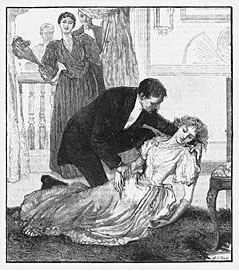
       One more possibility for the reason Victorian women frequently fainted was that they were actually just pretending to faint. It was considered very ladylike to swoon when women felt any sense of shock. This was meant to show their delicate nature and was a strong social cue for women whenever they saw something that might be scandalous or unladylike. Due to these social norms, women might have used fainting and thus fainting couches to get out of uncomfortable situations. If they wanted to avoid someone or something, they could faint. If they needed to use the toilet but didn’t want to announce it, they could faint. Fainting was one of the few ways Victorian women could change a subject or abruptly exit a room while still being considered ladylike. These social norms surrounding fainting couches can continue to tell us how women might have acted in the Farm House during the Victorian era since we know from the 1907 photo a fainting couch was present in the library at the time. There are a lot of different objects within the Farm House that continue to tell us more about the past, gender roles, society, fashion, and many other interesting historical topics.

Wednesday, October 12, 2016

Antique Spice Cabinet

The Farm House Museum has many different furniture objects in the permanent collection, quite a few of them dating back to the late 19th century which can give us a greater perspective on the people that lived during that time. One interesting piece of furniture is this Spice Cabinet, which hangs on the wall in the Farm House’s 1860s era kitchen. While there is not specific date for this cabinet, it can be assumed that it is from the late 19th century because other spice cabinets similar to the woodwork and the writing style of this cabinet are from the late 19th century. In all likelihood, this cabinet is from that time as well. While this Spice Cabinet is from the 1800’s, spices have been utilized since ancient history.When spices were first noted in historical records they were often traded goods that were seen as having healing properties. Within ancient Egypt, China and Mesopotamia spices were used for medicinal remedies and were often grown and purchased by the elite. Chinese courtiers even used cloves in the 3rd century BC
to make their breath smell sweet when addressing the Emperor. Ancient Indian surgeons would use mustard to ward off spirits and include ginger in their treatment. Ancient Romans would use spice-scented oils after baths to improve their skin tone. Spice prices were kept high throughout the medieval period due to the Arab monopoly on spice trade. The spice trade continued to grow throughout the world as spices were seen as a high commodity due to their unique tastes and projected health benefits. During colonial times in America, the British still controlled the spice trade, so it wasn’t until the revolution that the United States entered the world spice business. The spice trade was largely controlled by New England until the mid 1800’s when spice commerce became more decentralized. Still, spices remained a commodity used by upper class people. It was during this time that the Farm House’s Spice Cabinet was probably constructed.
 While spice cabinets had been common in other locations around the world before this time, Pennsylvania gave rise to traditional American spice boxes. Spice boxes were seen as a status symbol in colonial America as they were desirable and a luxury reserved for the wealthiest. These square boxes would often be found in the parlor area on top of other furniture, similar to sugar safes. Many of these boxes wouldn’t just have spices in them but other treasured items like jewelry, tea or even salt. They also would be designed to reflect the furniture fashion of the time. These boxes were mostly made in Pennsylvania but their simple design influenced other spice cabinetmakers. The Farm House’s Spice Cabinet reflects the simple rectangular shape of the Pennsylvania style.

One other thing to note about this Spice Cabinet is the spice names that are listed on the drawers. The first is cloves, a sweet and warming spice native to Indonesia and used most often in baking – especially this time of year as the holiday season approaches. The second is ginger; native to Southeast Asia this spice wasn’t used widely as a food seasoning until the 16th century. The third is allspice, which was discovered in Jamaica and is similar to cloves but is far more pungent. The fourth is pepper; native to India this spice is often called the king of spices and is found in many different forms. One of the other drawers is partially erased so the only word visible is “powder.” This could refer to many different spices as a lot of them have been ground and use powder at the end of there title. When looking inside the drawer there is small plaque that says mustard. Maybe the previous owners had erased some of the writing on purpose so they could put mustard in the drawer instead? Three of the drawers don’t have any writing on them at all so this could be where they put some other valuables or treasured items. On the top of the Spice Cabinet there is a box labeled salt, which isn’t connected to the Spice Cabinet. The reason that the saltbox isn’t connected to the Spice Cabinet is that salt isn’t a spice but a mineral. Salt, unlike spices, doesn’t come from a plant and it won’t lose flavor over time. This Spice Cabinet can teach us a lot about what people ate and how they flavored their recipes back in the 19th century.  Even though this object is period appropriate and was not actually in the Farm House back then, it is an example of what could have been in an 1860s era kitchen, and shows us the emphasis placed on spices, cooking, and flavor.

Monday, September 19, 2016

Man of the North Wind Chair


One interesting thing to look at in the Farm House Museum is some of the older furniture that has been in the house for many years. Within the main floor library there is a black chair with a carved picture on the backrest, which appears to look like a stylized Scandinavian man. This is actually called the Man of the North Wind chair and it belonged to Charles F. Curtiss, first dean of Agriculture, when he lived in the house. There is even a historic picture of the chair when it sat in the Curtiss library in 1907, the only known image of the historic interior of the house. This picture was used in an Iowa Agriculturalist magazine describing the room as a “well thought-out decorating plan.” It was in 1947, after Dean Curtis
s passed away, that Ames native Ann McCormack purchased the chair. The house wouldn’t see the chair again until 1976 when in
becoming the Farm House Museum, Mrs. McCormack would decide to donate it back to the historic home museum.

The chair itself seems to depict the north wind and may be one of a set of four different chairs. This mythological Norse-like figure is a common characteristic of a style of furniture commonly called “North Wind” Chairs. This type of furniture was popularized in the 19th and early 20th century often depicting the wind god Aeolus carved into the backrest of a chair. Typically the images would depict him either stoic or blowing wind in a “grotesque” manner. The maker of this chair decided to carve a more stoic and haunting depiction.

This type of imagery was part of the Greek and Renaissance Revival furniture movements. The Greek style, which happened in both Europe and America, would put images of Greek gods on furniture with curved legs and dark ebonized wood. The Renaissance Revival style would try to mimic 16th century designs using mahogany and walnut woods while having high relief carvings of flowers or classic figures to reflect the high style of the renaissance period. This chair is different however because of the Norse imagery, oval solid back rest, rounded seat, slightly akimbo legs and the overall rustic look of the chair’s design.
 
While this chair has some connections to the Renaissance Revival movement, it also is connected to the Black Forest style. Black Forest carvings come from the late 19th century, originating in Switzerland, not Germany as
commonly believed, and often depict detailed animals and plants made out of heavily carved wood. Some of the furniture that comes from this style depicts woodsmen that look similar to the Norse figure on this chair. The chair’s rustic look and rounded seat shows that the carver was at a minimum inspired by the Black Forest style, making a chair that wasn’t conforming to the current styles of that period. Ultimately, the Man of the North Wind chair doesn’t fit nicely into any specific style of its period. This type of furniture with a mythical figure on the backrest of the chair that has long flowing hair, has characteristics of several different styles. This chair would have been built around 1900. While the chair’s style is a little different for what was once rural Iowa, it is this uniqueness that make it so treasured and provides insight into the history of the Farm House, its owner Charles Curtiss, and early Iowa State.

Friday, July 29, 2016

The Helen Curtiss Arbor Gate


A typical visitor at Farm House will enter the museum through its south-facing front door. Rarely does that visitor stumble upon the beautiful arbor on the east of Farm House. With thousands of burgeoning concord grapes spilling over the Osage orange and eastern red cedar wood structure, the arbor is a quiet spot to cool off in the shade and uncover some campus history!

The arbor gate was originally designed circa 1925 by Helen Curtiss, the youngest daughter of Dean of Agriculture Charles F. Curtiss, as a senior class project. She and her family lived in Farm House from 1897 through 1947 - the longest stay of any other residents! The family was known to be kind and approachable, so many students at Iowa State during the Curtiss era referred to Farm House as the "Curtiss House" instead.

Helen was born at Farm House on September 14th, 1901 in the second floor's southeast bedroom. She quickly grew into the "mischievous and vivacious" woman she is remembered as by her friends today. Playing with paper dolls in the Farm House parlor, riding the elevator in Agriculture Hall (renamed Curtiss Hall in October of 1947) up and down with her friend Marie Mortensen, riding horses through campus, and hosting waffle parties on Sunday evenings were among her most favorite things.


Helen, Edith, and Ruth Curtiss, October 1908 
Helen holding two piglets, ca. 1912
Oftentimes the question is asked during a visit to the Farm House Museum, "Are there any ghosts?" This is highly unlikely, but it has been suggested that Helen Curtiss' ghost would pull back the lace curtains hanging in the window of her old bedroom to see which boyfriend was going to take her out for the night. Being an exceptional beauty and thrill-seeker, it is no surprise that Helen was notorious for sneaking out of Farm House while her mother and father were fast asleep!

Following Helen's graduation from Iowa State University, although it was still called Iowa State College at the time, she left Farm House in 1923. She married soon after to become Mrs. Helen Curtiss Whittaker. The quaint arbor gate she left behind at Farm House inevitably eroded with time, but the Class of 2002 funded a reconstruction of the arbor, herb garden, and water well. Because it is in the museum's permanent collection, visitors for generations to come may enjoy it.


Next time you walk by Farm House Museum, take a moment to experience this literally hidden gem - the grapes sure are tasty when they ripen up in the autumn!

Farm House Museum will close on Friday, July 29th at 4 PM until Monday, August 22nd at 12 PM. We hope to see you soon!

Tuesday, July 12, 2016

"Waste Not, Want Not" Trivet

Hot pads, table mats, pot holders, heat protectors... We each have our own name for what we put down to keep hot pans from burning into our countertops and dinner tables. The "real" name for such a device is a trivet.

"Trivet" originates from Late Middle English's borrowing of the Latin word tripes, or triped (tri- "three-legged" + pes, ped- "foot").  Traditionally, trivets are metal tripods that hold cooking pots above open flames - a design that ensures a steady surface for preparing food on uneven grounds. Metals were the first medium of constructing trivets, but that design has changed tremendously over the decades. Now trivets are commonly made from something as simple as a folded towel or an extra piece of tile. They may also be as complicated as intricately woven cast iron or as creative as wine corks wedged into a wooden frame!


Just as the design was revised, so too was the purpose of trivets altered. Trivets were previously used in the process of cooking (suspending cooking pots over a fire), but now they are mainly used after cooking is complete (protecting surfaces and hands from the bottoms of scalding pans). Because today's ovens come fully equipped with metal racks to place dishes on, three-legged trivets are certainly outdated in 21st century cooking. However, outdoor grills are a close relative to the original trivet.  

Why is the trivet located in the Farm House Museum so special? The proverb "Waste Not, Want Not" is carved into it. This exact saying was first recorded in 1772, but the earlier "Willful waste makes woeful want" can be traced back to 1576. Both versions suggest that wastefulness leads to wanting, a state of being that pioneer families as well as Farm House residents knew all too well, especially in regards to preparing food.

With large families, multiple students, and frequent visitors inhabiting Farm House year-round, cooking and dining was costly and demanding. Mary Welch, wife of Iowa State University's first president, Adonijah Welch, was instrumental in developing efficient cooking procedures. These are noted in Mrs. Welch's Cookbook, which you can see on display at Farm House Museum! Many modern cookbooks, food network programs, and culinary blogs have been influenced by the "Waste Not, Want Not" wisdom.

Come find Farm House Museum's lovely "Waste Not, Want Not" trivet in the old kitchen today! We are open Monday-Friday, 12-4 PM.